 |

 |
 |
 |
 |
 |
Improving Water Quality
The Lower Boise Watershed Council works to address and improve water quality issues in our watershed. Water quality improvements focus on restoring or maintaining beneficial river uses, such as fish habitat and recreation.
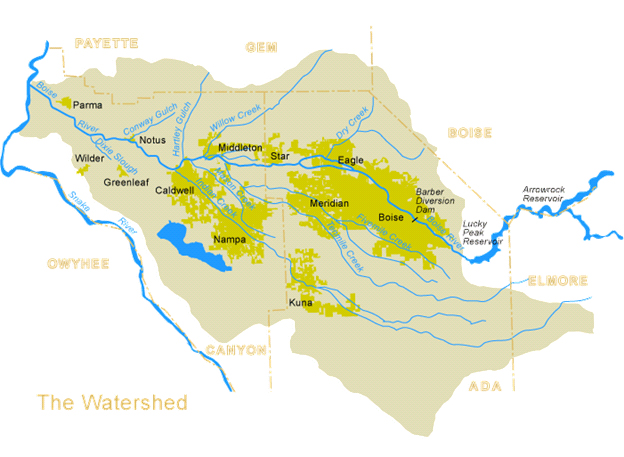
The lower Boise Watershed drains 1,290 square miles of rangeland, forests, agricultural lands, and urban areas. The lower Boise River itself is a 64-mile stretch that originates at Lucky Peak Dam to the east of Boise, and flows northwesterly through Ada and Canyon counties through the cities of Boise, Eagle, and Caldwell, Idaho. The river then flows into the Snake River near Parma, Idaho at the Idaho-Oregon border.
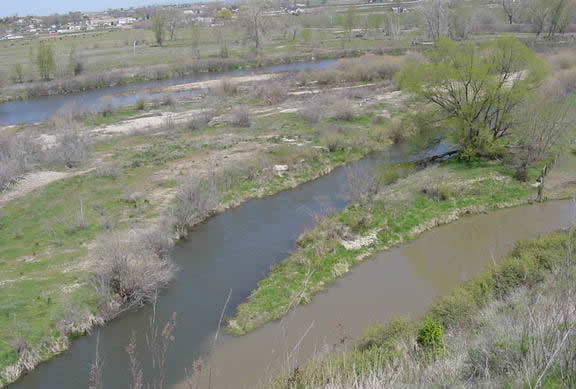
High sediment discharge to the lower Boise River from Mason Creek (at bottom of photograph). |
Certain reaches of the mainstem lower Boise River and some of its tributaries are impaired by pollutants. By figuring out exactly where the problems are, we can figure out the most effective solutions. For example, the entire mainstem Boise River and many of its tributaries have too much sediment. Within the river, temperatures are elevated, phosphorous concentrations are high, and bacteriological pathogens have also been found. In addition, uses in the downstream Snake River are limited primarily by phosphorous, sediment, and bacteria from the lower Boise River. So the Council is currently focusing on reducing sediment, bacteria, phosphorous, and temperature. |
Grant Assistance
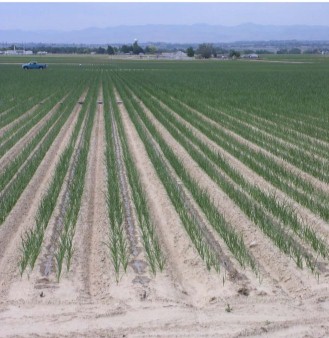
The 319 Grants provide financial incentive to implement on-the-ground Best Management Practices. |
A grant program is available to agricultural owners and operators in Canyon County. We administer these grants jointly with the Canyon County Soil Commission, with assistance from NRCS and ISCC. Contact lbwcexecutivedirector@gmail.com for more information. |
Data Reports
Available Data
Over the last 30 years, the LBWC and local stakeholders have studied the lower Boise River extensively. The most thorough compilation of water quality data is maintained by the U.S. Geological Survey.
 USGS Water Quality Data
In addition, the USGS maintains a real-time gage at Parma.
http://nrtwq.usgs.gov/id/
Published Reports
Related Web Links
|
Department of Environmental Quality |
|
Environmental Protection Agency (EPA) |
|
Idaho Association of Soil Conservation Districts |
|
Idaho Department of Water Resources |
|
U.S. Bureau of Reclamation: Pacific Northwest Region |
|
U.S Army Corps of Engineers: Walla Walla District, Boise Outreach Office |
|
Idaho Soil Conservation Commission |
|
Idaho OnePlan: Farm and Ranch Resource Center |
|
Idaho State Department of Agriculture |
|
Treasure Valley Hydraulic Project |
|
Boise River Water District 63 |
|
Lower Boise Pollutant Trading Project. For more information and the full report on the Pollutant Trading Pilot Project, see the Idaho Department of Environmental Quality website |
News
|
2010, January 9: Boise's innovative plan to build wetlands is being watched across the country, Idaho Statesman News Story by Bethann Stewart (PDF, 24 kb) |
|
2010, January 3: We can all help to ensure the Boise River stays clean, Idaho Statesman Guest Opinion by Johanna Bell (PDF, 22 kb) |
|
2007, November 24: Conserving, Reusing Wastewater is Solution to Storage, Idaho Statesman Guest Opinion by Jack Harrison (PDF, 400 kb) |
|
2005, April 18: Reducing Phosphorous Levels in Rivers is Community Effort, Idaho Statesman Guest Opinion by Tom Dupuis (PDF 3.5 MB) |
|
2005, February: Phosphorous Inputs into Boise River Must Be Reduced, Western Canyon Chronicle interview with Sherrill Doran (PDF, 2 MB) |
|
2001, June 22: Cleaner River Benefits All of Us, Idaho Statesman Guest Opinion by Tom Dupuis and Tom Krumsick (PDF 300 kb) |
|
2000, November 26: Clean Water Act Revisited, Boise River Represents Best, Worst, of Water Care, Idaho Statesman Special Report (PDF 3 MB) |
|
2000, April 22: Deal Aims to Cut Pollution; Project Will Lower Phosphorous in Boise River via Effluent Trading, Idaho Statesman (PDF 700 kb) |
|
1998, November 15: Boise River Will Play Guinea Pig for Cleanup; Trading Aims to Aid Farms, Industry, Idaho Statesman (PDF 400 kb) |