 |
|
|
|
|
|
|
|
 |
|
||||||
 |
 |
 |
 |
 |
 |
 |
|

 |
|
|
|
|
|
|
 |
 |
 |
 |
 |
 |
|
|
Phosphorous in the Lower Boise River
In 1998, the total maximum daily load (TMDL) allocation for sediment and bacteria was completed for the lower Boise River. The TMDL described how certain pollutants needed to be reduced in the Boise River to maintain our beneficial uses of the river for fishing, recreation, and consumption. (See Sediment and Bacteria TMDLs for more information.) Limited technical analysis of nutrients was captured in Appendix J of that TMDL.
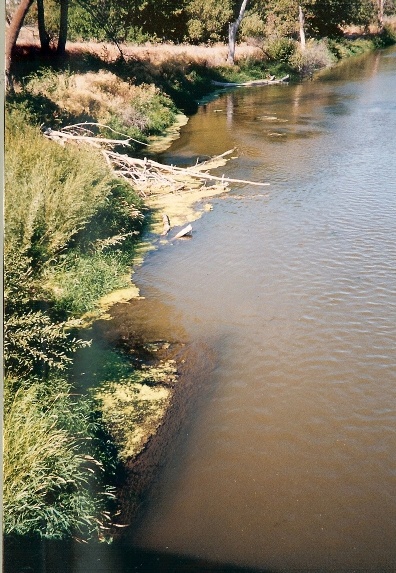
Lower Boise River shoreline below Parma Bridge, showing some algae growth (August 2002) |
The good news from the TMDL was that initial analyses indicated that phosphorous, a type of nutrient that causes water quality problems like algae blooms, is not at high enough concentrations to create problems for the lower Boise River. A nutrient sub-basin assessment (PDF 1.1 MB) was completed by DEQ in 2000. The bad news is that phosphorous is a problem for the Snake River. All the tributaries to the Snake River will be required to reduce phosphorous to help the Snake River meet its beneficial uses. For the lower Boise River, that's a reduction of more than 75 percent. For more information, read the Snake-River Hells Canyon TMDL on DEQ's web site. To meet this huge reduction, the Lower Boise Watershed Council and DEQ created an Implementation Plan to address phosphorous in the Lower Boise River. Phosphorous in our rivers and creeks comes from a variety of sources, including animal and human waste, disturbed soils on farms and construction sites, some industries, and fertilizer runoff from urban storm drains and agricultural lands. The entire Boise River watershed contributes to the phosphorous problem, and it will take a watershed-wide approach to solve it. Why is all of this important? Excessive phosphorus concentrations can cause algae to grow out of control, leading to nuisance conditions that can limit recreational uses. In addition, as the algae completes its life cycle and dies, bacteria decomposition of algae depletes the available oxygen in the river. Trout and salmon in particular need well oxygenated water to survive. |
Because phosphorous comes from such a variety of sources, it is difficult to decide who needs to reduce their contributions and by how much to achieve water quality goals. For the urban portion of the watershed, our municipal wastewater treatment plants will need to install more advanced technologies. In addition, controlling runoff from construction sites and building wetlands to treat stormwater before it reaches to river are both viable options. Homeowners can help by only applying the fertilizers they need, or by using mulched lawn clippings instead of fertilizer.
In the agricultural arena, farmers can reduce phosphorous by controlling runoff, constructing buffer areas near return ditches and streams, building sediment ponds, and changing irrigation and plowing practices.
Development of an Implementation Plan
As part of the Snake River-Hells Canyon TMDL process, the Lower Boise River watershed was assigned reductions in phosphorus to help reduce algae growth downstream in the Snake River system. Consistent with Idaho Code 39-3611(6), as part of the Snake River-Hells Canyon TMDL, DEQ needed to develop a plan to meet such allocations. Since 2005, the Lower Boise Watershed Council and DEQ have worked on developing a fair and equitable way to achieve phosphorous reductions. Part of this process included a series of free, public workshops and technical working group meetings. As a result of this process, the Lower Boise Watershed Council developed a recommended allocation approach for DEQ. This allocation document was submitted to the agency in August 2007. Public comment on this document led DEQ to publish the final implementation plan in July 2008. The Lower Boise Implementation Plan: Total Phosphorous document describes source-specific requirements, assumptions, timeframe, and targets for phosphorous reductions. The Executive Summary (PDF 143 KB) gives an overview of the targets and implementation strategies, while the full document provides background information and analyses that led to this plan
Implementation Plan Highlights
To reduce nuisance algal growth in the Snake River upstream from Brownlee Reservoir, the Snake River total maximum daily load (TMDL) established a May 1 to September 30 instream total phosphorus target of 0.07 milligrams per liter (mg/L) in concert with a mean growing season limit for chlorophyll a of 14 micrograms per liter (ug/L). To reach these targets, concentrations of total phosphorus in the Lower Boise River must be reduced by more than 75 percent. The Lower Boise River Implementation Plan allocations, when fully implemented, are projected to meet the instream target concentrations of total phosphorus in the Snake River. The implementation strategy includes the following components:
- Significant reduction (98 percent) of phosphorus in effluent from municipal wastewater treatment plants
- An overall total phosphorous reduction goal of 50 percent by stormwater dischargers, as applied to new development and substantial redevelopment
- Voluntary BMP implementation on agricultural lands, contingent on available funding levels and previously-developed implementation plans
- Assumption that over time, agricultural land will convert to other land uses (urban land has a lower phosphorus loading rate, on a per acre basis, than agricultural land)